
The Emancipation of Bahamian Fashion
Today is Emancipation Day, and I’ve been thinking about freedom beyond its legal definition.
I’ve been thinking about cultural freedom. Creative freedom. The freedom to decide what beauty, sophistication and style look like for ourselves.
The Kanoo dress references the visual language of imprisonment and the ways Bahamian fashion remains confined by standards inherited from colonialism and reinforced by global culture.
Colonialism did not only control land, labour and government. It shaped taste.
It taught us what was considered proper, respectable and refined. European dress became associated with civility, education and status, while African, Indigenous and local forms of expression were often treated as primitive, excessive or inappropriate.
Those ideas did not disappear when slavery ended. They did not disappear when The Bahamas gained independence. They survived through respectability politics.
Respectability politics taught generations of Bahamians that acceptance could be earned through presentation: by dressing correctly, speaking correctly and behaving in ways that made colonial society comfortable. Clothing became more than clothing. It became proof that you were respectable, employable and worthy of being taken seriously.
Even now, those standards continue to shape the way we dress and the way we judge one another.
We are often taught that professionalism looks foreign. Luxury looks European. Streetwear looks American. Trendiness comes from somewhere else. Bahamian culture, meanwhile, is frequently reserved for festivals, costumes, tourism campaigns and national celebrations.
We are encouraged to wear our culture occasionally, but not always to imagine our culture as the foundation of contemporary fashion.
That is a form of confinement.
It means we are constantly looking outside ourselves for approval. We wait for another country to decide what is desirable, then reproduce it locally. We measure our creativity by how closely it resembles what already exists elsewhere.
We become prisoners to global fashion trends.
This does not mean Bahamian designers should reject outside influence. Fashion has always been shaped by cultural exchange. The issue is not influence. The issue is dependence.
There is a difference between participating in a global conversation and allowing the global market to speak for us.
Creative emancipation means developing the confidence to begin with ourselves.
It means looking at Junkanoo, straw work, Goombay, sailing, rake-and-scrape, architecture, landscape, labour, folklore and everyday Bahamian life as sources of serious design language. Not as decoration added after the fact. Not as novelty. Not as costume.
As foundation.
The Kanoo dress exists within that question. It uses a familiar cultural object, but it also references restraint and imprisonment. It asks what happens when an object associated with movement and survival is transformed into something that restricts the body.
That tension mirrors the condition of Bahamian fashion.
We are surrounded by a rich visual culture, yet we can still feel limited in how we are allowed to use it. We are expected to create, but within standards established elsewhere. We are encouraged to celebrate Bahamian identity, but often only in forms that are already familiar, marketable and easy to consume.
Real emancipation requires more than celebration. It requires interrogation.
We have to question why some aesthetics are considered elegant while others are called loud. Why some materials are considered luxurious while local materials are treated as craft. Why foreign references are seen as sophisticated while Bahamian references are reduced to cultural themes.
We also have to question our own gaze.
When we see a Bahamian garment, do we judge it on its own terms, or do we immediately compare it to Paris, London, New York or Milan? Do we believe something is valuable because it reflects us, or only after it has been validated somewhere else?
A free fashion culture cannot be built through imitation alone.
It must have its own memory, its own symbols and its own point of view.
The emancipation of Bahamian fashion is not about returning to the past. It is about refusing to treat the past as something we must escape in order to appear modern.
Our history is not the opposite of innovation.
It is material.
The goal is not to create clothing that merely looks Bahamian. The goal is to develop a fashion language that thinks Bahamian.
A language shaped by where we come from, how we live, what we have endured and how we imagine ourselves moving forward.
Political emancipation ended one form of captivity. But cultural emancipation is an ongoing process.
It begins when we stop waiting for the world to define what Bahamian style should be.
It begins when we decide that our culture is not a limitation.
It is the source.
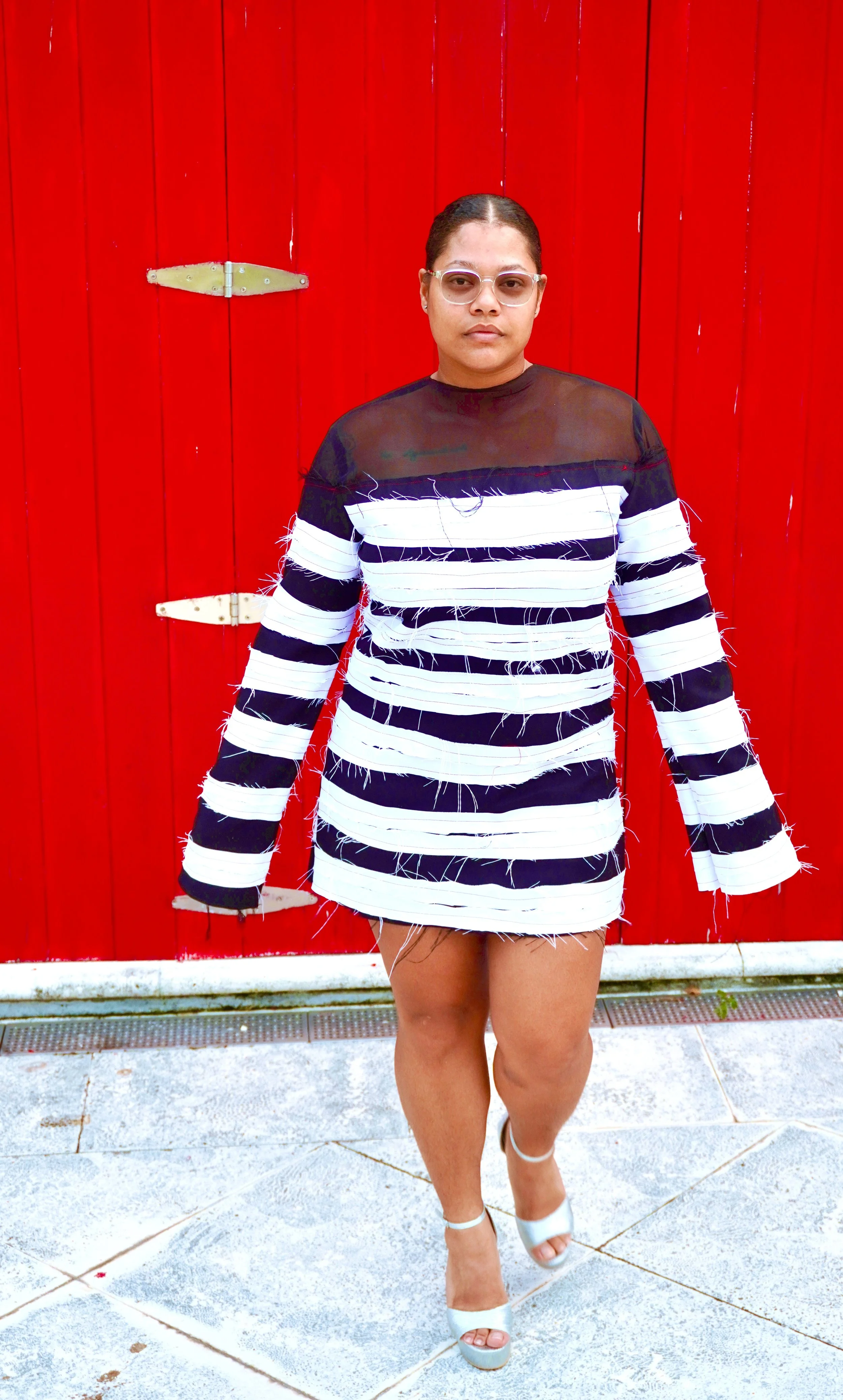
Model wearing the Kanoo dress in rehearsals
